English
Wednesday, 31 December, 2014
14
ALANBAA
Ukraine crisis forced into
suspended animation for 2015
5 Things to Know About
Aviation in Asia
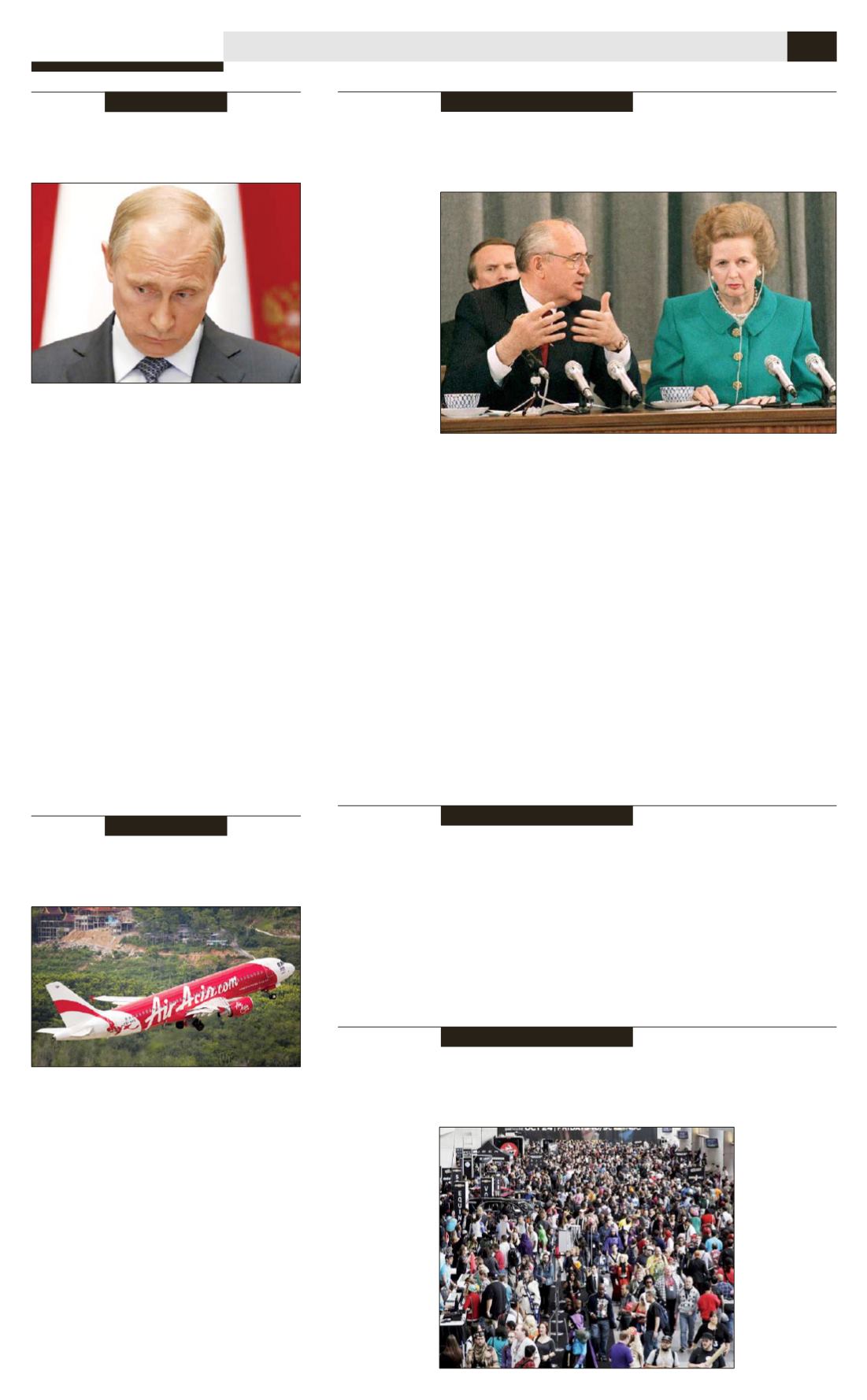
Reuters -Western economic sanc-
tions against Russia were expect-
ed to have no effect. Yet they have
causedmuch pain. They were also
meant to have a clear goal. So far,
they don’t.
“The war that dare not speak its
name,” to quote New York Universi-
ty professor Mark Galeotti, is a prob-
lemboth for Russian President Vladi-
mir Putin and for European leaders
who have struggled to keep a unit-
ed front since Russia moved to annex
Crimea – and must decide in March,
2015 whether to roll over their sanc-
tions against Moscow.
Defining a strategy beyond sanc-
tions is all the more important for
Europe now that Russia is sending
all the signals that it has no inten-
tion of retreating from its power-
flexing policy, from the Baltic to the
Balkans. Moscow is hinting that it
can take the pain fromprolonged
economic isolation – at least for
the next couple of years. Even be-
fore the steep fall of oil prices, and
the subsequent crisis of the ruble,
that was a highly optimistic view,
but the implication of the Krem-
lin’s position is clear: don’t expect
any short-term change.
The harmdone to a Russian econ-
omy already immersed in deep
problems before anything hap-
pened in Ukraine has been sub-
stantial. The rouble fell 40 percent
against the U.S. dollar in 2014. Cap-
ital flight may have topped $130
billion over the same period, ac-
cording to official estimates. The
Central Bank of Russia tried with-
out success to defend the rouble
and keep inflation under control,
taking its key interest rate to an
unprecedented 17 percent, and
putting a brake on growth. Mean-
while, sinking oil prices are push-
ing Russia’s resource-dependent
economy ever deeper in the hole.
Gross domestic product will bare-
ly increase in 2014 and shrink by
4.5 percent in 2015 if oil prices stay
around the $60-a-barrel mark, ac-
cording to the central bank.
The European economy is hurt in
return. Some countries are hit by Pu-
tin-ordered embargoes on food or
clothing imports. Others are worried
about their energy dependence on
Russia. Western diplomats and busi-
nessmen think there’s little chance
Moscow will ever cut off gas to Eu-
rope. But no one has ever accused
Putin of being predictable.
This state of affairs will continue
as long as Europeans don’t agree on
what they want to achieve. Is Putin
open to a deal that would ease ten-
sions in eastern Ukraine? Or has he
embarked on a long game of brink-
manship fromwhich he will not retreat
whatever the economic cost?
The answers to these questions
lie with the Kremlin. But as long as
Europe lacks a clear objective, the
Russian president will be left tomis-
interpret mixedmessages – and the
Ukraine crisis remain in suspended
animation.
AP - An AirAsia jet with 162 peo-
ple on board disappeared Sunday
while flying from Indonesia to Sin-
gapore. Here are five things to know
about aviation in Asia, where grow-
ing demand is creating daunting
safety challenges:
1. As the economies of countries
in Southeast Asia continue to grow,
more people have the financial
means and appetite to travel. Air-
lines are struggling to ensure that
their training and safety standards
keep pace with the demand.
2. There are currently 1,600 air-
craft operating in Southeast Asia
alone, according to Brendan So-
bie, an aviation analyst in Sydney.
He says it’s the only region in the
world with as many aircraft on or-
der as are already in service, an in-
dication that the rapid growth will
continue.
3. The Asia-Pacific region accounts
for 31 percent of global air passen-
ger traffic, according to the Inter-
national Air Transport Association.
Within two decades, that figure is
forecast to jump to 42 percent. Asia
is expected to add an extra 1.8 bil-
lion annual passengers for an over-
all market size of 2.9 billion.
4. Asia doesn’t have enough train-
ing programs to produce all the pi-
lots it needs, says David Greenberg,
a former Delta Air Lines executive.
He says a global shortage of pi-
lots has prompted pilot poaching,
as carriers in the Middle East and
Asia have looked to the U.S., Cana-
da, Australia and Europe to fill the
gap. Boeing projects the Asia-Pa-
cific region will need 216,000 new
pilots in the next 20 years, themost
of any region in the world.
5. Wages for pilots and techni-
cians in Southeast Asia have not ris-
en fast enough to compensate for
the cost of training, which discour-
ages people fromwanting to pursue
an aviation career, says Lim Chee
Meng, the chief executive of Mil-
ComAerospace Group, a Singapore-
based aviation training company.
The dearth of trained staff means
there are fewer workers to juggle
an ever-growing workload—and
that comes with safety risks.
International
Aviation
U.S. population reached
more than 320 million
CIA was responsible for half of
UFO sightings in the 50s and 60s
Secret files shed light on first
Thatcher-Gorbachev talks
Population
Espionage
History
UPI - According to a
new report from the Cen-
sus Bureau, the U.S. popu-
lationwill be 320,090,857
by January 1, 2015. The
new total will mark a 0.73
percent increase since
New Year’s Day of 2014,
when the populationwas
317,756,670 - a 2,334,187
difference.
The latest totals are es-
timates, projections using
population trends to ex-
trapolate data collected
during the last census.
According to the agen-
cy’s advanced math, a
combination of factors
including the number of
births, deaths and immi-
gration in and out of the
country averages out to
a newU.S. resident being
UPI - The CIA noted
via Twitter Monday
that it was responsi-
ble for at least half of
UFO sightings in the
1950s and 60s.
“Reports of unusual
activity in the skies in
the‘50s? It was us,”the
agency tweeted.
AFP - Classified docu-
mentsmade publicTues-
day shed light on the po-
litical courtship between
Britain’sMargaret Thatch-
er andMikhail Gorbachev
-- whom she famously
declared she could “do
business”with.
After Gorbachev’s first
official visit to Britain in
1984, four months be-
fore he became Soviet
leader, Thatcher praised
his“charmand humour”
as both sides sought
to improve East-West
relations.
The warmth of their
relationship even sur-
vived one of the most
notorious defections of
the Cold War -- double
agent Oleg Gordievsky,
who had been head of
the KGB’s London sta-
tion, in 1985.
The documents were
released by the Nation-
al Archives in London
under the 30-year rule,
which allows previously
secret government files
to bemade public three
decades on.
Thatcher, who died
in 2013, wrote to then
US president Ronald
Reagan following Gor-
bachev’s visit.
“He is relatively open
inmanner and intelligent.
He is affable and has some
charmand humour,”she
wrote.“I certainly found
himaman one could do
business with. I actually
rather liked him.”
Despite that positive
impression, Gorbachev
was also subjected to the
“Iron Lady’s” legendary
sharp tongue.
“He was clearly not
used to the sort of rigor-
ous questioningwhich he
got fromme on things like
human rights in the Sovi-
et Union,” she added.
The document the
tweet links to is a pre-
viously confidential re-
port on the testing of
the U-2 spy plane at al-
titudes of over 60,000
feet. It says half or more
of supposed UFO sight-
ings were actually times
when they were flying
British officials alsowere
struck by his vivacious wife
Raisa, who at one point
on the trip dropped in to
royal jeweller Mappin and
Webb to buy some gold
earrings set with diamonds
and rubies.
Less glamorously, she
also sent a book of 500
Belarusian potato reci-
pes to Britain’s agricul-
ture minister after the
trip, following a conver-
sation the pair had on
the subject.
“If you have anyone
who reads Russian and
has a fondness for pota-
toes, we would be happy
to lend it,”wrote senior
agricultureministry civil
servant Ivor Llewellyn to
Downing Street colleague
Len Appleyard after re-
ceiving the book.
Gordievsky’s defection to
Britain -- he shook off KGB
agents trailing him inMos-
cow and boarded a train to
Finland before being tak-
en over the border in the
boot of an embassy car --
threatened to cast a ma-
the plane at high alti-
tudes, which people
didn’t realize was pos-
sible at the time.
Though they realized
people were spotting
the plane by cross-ref-
erencing the sightings
with when and where
the plane was flying,
jor shadowover improving
East-West relations.
The files contain a
string of documents
about Gordievsky un-
der the codename HET-
MAN -- the title used for
Cossack military com-
manders -- including a
letter from Thatcher to
Reagan informing him
of the defection on Sep-
tember 6, 1985.
Britainwas concerned
about Gordievsky’s wel-
fare without his family
and pushed for his wife
and two daughters to
be quietly allowed to
leave the Soviet Union
and join him.
The MI6 foreign in-
telligence agency even
got word to their Soviet
counterparts that there
would be a high-profile
mass expulsion of KGB
agents fromLondon iden-
tified by Gordievsky if
they did not agree.
But Moscow did not
budge.
On September 7, amid
awave of tit-for-tat diplo-
added to the total every
16 seconds.
The United States is
thirdmost populous na-
tion in the world. But the
twomost populous coun-
tries, China and India, each
host roughly four times
as many people as the
United States.
India, the secondmost
populous country in the
world at 1.25 billion, is ex-
pected to feature - along
with Africa - some of the
world’s sharpest popula-
tion increases in the com-
ing decades. China’s pop-
ulation - the world’s most
populous at 1.36 billion
-- is already beginning to
plateau. The new report
estimates the world pop-
ulation at 7.21 billion.
the agency couldn’t in-
form the public of that
knowledge. The agen-
cy says the document
explaining that scenar-
io was the most wide-
ly read document re-
leased this year from
their database.
The U-2 is now flown
by the United States Air
Force, and 104 have been
built in total. One was
shot down by the Soviet
Union inMay of 1960 at
70,500 feet during the
first attempt to cross the
Soviet Union by going
fromPakistan’s air space
to Norway’s.
matic expulsions, Thatch-
er wrote to Gordievsky
and told him that Brit-
ain would not be push-
ingMoscow for his fam-
ily to be returned.
“We had to face up to
the reality of the kind of
people with whom we
are dealing and the fact
that their values are very
different from ours,” she
wrote.
“Please do not say that
life has nomeaning. There
is always hope. And we
shall do all we can to help
you through these diffi-
cult days.”
Gordievsky’s family
eventually joined him
in 1991, but the years
of separation had taken
their toll and themarriage
soon broke down.
The next recorded cor-
respondence between
Thatcher and Gorbachev
after Gordievsky’s defec-
tion came when he sent
her early birthday wishes
on October 12 and sug-
gested that their coopera-
tion should continue.


